Showing posts with label Creationism/Evolution. Show all posts

Sunday, August 13, 2006

Discussing Creationism Part XXIII

Can the Bible and evolution be reconciled?

The Bible states that God created the world in 6 days and that Adam, Eve and Noah were historical figures. Science can not accept this and instead teaches that the Creation of the world and the flood are myths.

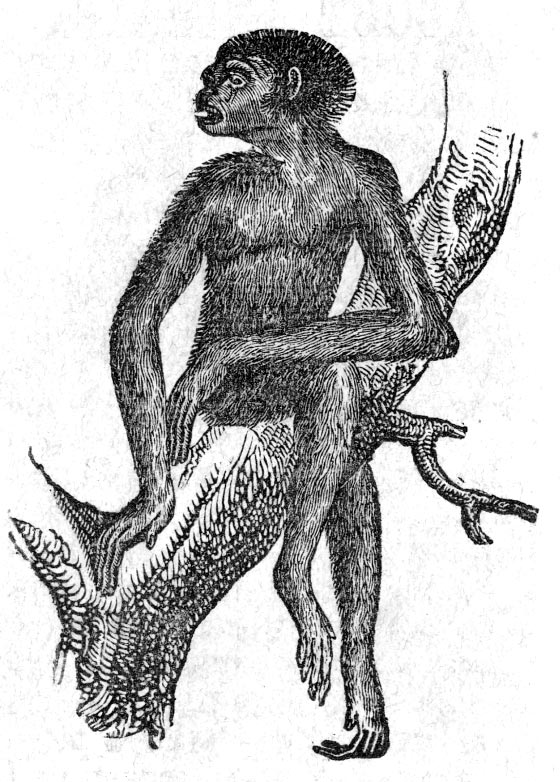
Evolution teaches that man and ape decended from a common ape-like creature. The Bible teaches that Adam was created from dust.

After the flood, drastic changes occurred in all life. Evolution and Natural Selection teach that biological changes occur over millions and millions of years. According to the Biblical timeline, the flood happened about 1650 years after Creation, leaving not much time for the slow changes of evolution.

How could this have been?


Sources:
About.com Evolution and Religion Most interesting. Be sure to read the last paragraph.

American Atheists


Previous Discussions:
Discussing Creationism: The Initial Argument
Part II: Two Questions about the Ark
Part III:The Volume of the Ark
Part IV: The Weight and Sturdiness of the Ark
Part V:What is a Myth
Part VI: Gilgamesh
Part VII: The Biblical View of Noah
Part VIII: Gathering of the Animals
Part IX Evolution
Part X The First Evolutionist
Part XI The Notebook
Part XII Erasmus Darwin
Part XIII Aristotle
Part XIV Middle Ages
Part XV Kant's Quotation
Part XVI Kant in Context
Part XVII: The Beliefs that influenced Darwin
Part XVIII: John Henslow
Part XIX: Darwin's Infallibility
Part XX: Darwin's Thoughts on Apes and Human
Part XXI:Lyell's Principles of Geology
Part XXII: Natural Selection

Sunday, August 06, 2006

Discussing Creationism Part XXII

Darwin observed the Artificial Selection used by plant and animal breeders to keep certain desirable traits in the breeding stock. By this process they were able to maintain a certain variety of the animal. (eg. in dogs-Labrador Retrievers or Poodles )

Darwin observed the varieties of life and their similarities and concluded that Natural Selection had occurred. The competition for survival and reproduction had caused the stronger variations of the species to survive. Eventually, a new species developed.

Natural selection is dependent upon the environment. Different environments would produce different species as different adaptations would be required to survive in them. Thus more than one species could develop from one ancestor.

During this time, Darwin became growingly agnostic. Not only was God not needed in natural selection but he felt that the intraspecies competition was incompatible with a benevolent Creator.


Sources:
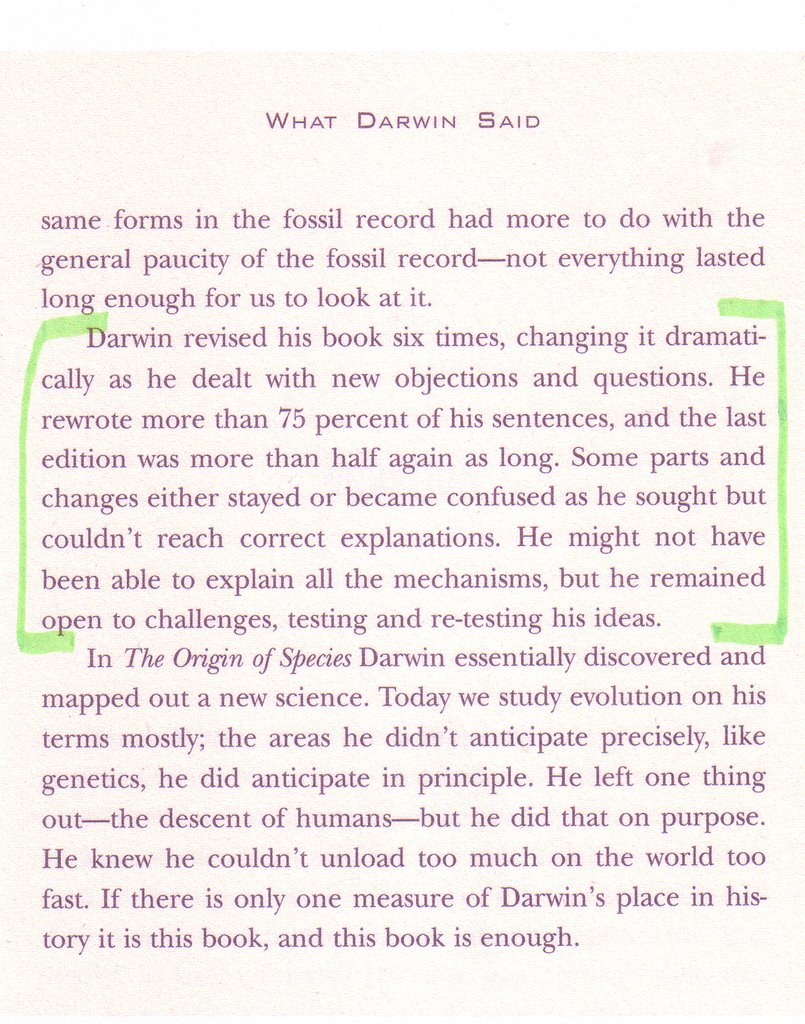
Evolution by Edward J. Larson
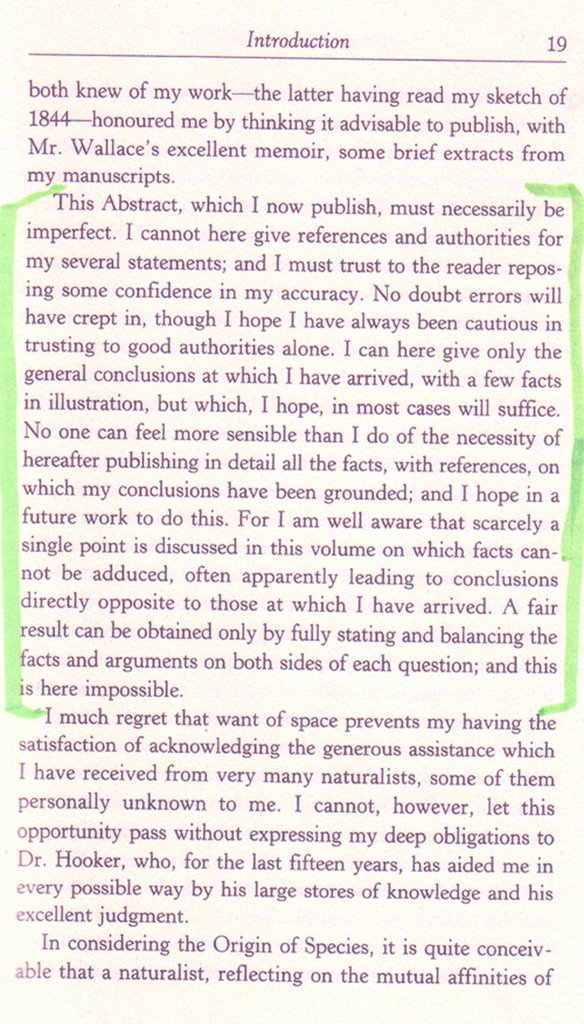
Origin of Species by Charles Darwin


Previous Discussions:
Discussing Creationism: The Initial Argument
Part II: Two Questions about the Ark
Part III:The Volume of the Ark
Part IV: The Weight and Sturdiness of the Ark
Part V:What is a Myth
Part VI: Gilgamesh
Part VII: The Biblical View of Noah
Part VIII: Gathering of the Animals
Part IX Evolution
Part X The First Evolutionist
Part XI The Notebook
Part XII Erasmus Darwin
Part XIII Aristotle
Part XIV Middle Ages
Part XV Kant's Quotation
Part XVI Kant in Context
Part XVII: The Beliefs that influenced Darwin
Part XVIII: John Henslow
Part XIX: Darwin's Infallibility
Part XX: Darwin's Thoughts on Apes and Human
Part XXI:Lyell's Principles of Geology

Sunday, July 30, 2006

Discussing Creationism Part XXI

Before Charles Darwin left to go on the Beagle, he was given a copy of Sir Charles Lyell's Principles of Geology. This book was to have a great influence on his interpretions of what he observed while on his voyage.

Lyell was writing about the uniformitarian theory, first introduced by James Hutton, that the earth changed by natural forces over a long period of time.

Evolution requires uniformitarianism in order to work.

This was different from the catastrophic viewpoint. Catastrophism holds that earth was immediately shaped by world-wide catastrophes. (During the 1700-1800's, it was also believed that all of creation was destroyed and had to be reestablished during these catastrophes.)


No one can deny that some of the changes in our earth are due to slow acting forces such as erosion but the sudden changes produced by catastrophic events can not be denied either. Earthquakes and floods leave their mark, quickly.


Sources:
Origin of Species by Charles Darwin
Evolution by Edward J. Larson
Physical Geography
Science Clarified
Encylopedia Britannica

Previous Discussions:
Discussing Creationism: The Initial Argument
Part II: Two Questions about the Ark
Part III:The Volume of the Ark
Part IV: The Weight and Sturdiness of the Ark
Part V:What is a Myth
Part VI: Gilgamesh
Part VII: The Biblical View of Noah
Part VIII: Gathering of the Animals
Part IX Evolution
Part X The First Evolutionist
Part XI The Notebook
Part XII Erasmus Darwin
Part XIII Aristotle
Part XIV Middle Ages
Part XV Kant's Quotation
Part XVI Kant in Context
Part XVII: The Beliefs that influenced Darwin
Part XVIII: John Henslow
Part XIX: Darwin's Infallibility
Part XX: Darwin's Thoughts on Apes and Human

Sunday, July 16, 2006

The Lighter Side of Discussing Creationism and Darwin


Take this quiz to find out how well you know Darwin.


One day the zoo-keeper noticed that the orang-utan was reading two books - the Bible and Darwin's The Origin of Species. In surprise he asked the ape, "Why are you reading both those books"?
"Well," said the orang-utang, "I just wanted to know if I was my brother's keeper or my keeper's brother." Darwin Jokes and Evolution

Sunday, July 09, 2006

Discussing Creationism Part XX


When Charles Darwin wrote Origin of Species, he did not want his theory to be dismissed so he did not mention that humans were included in the evolutionary process as well.

A quote from a private letter used in Cynthia L. Mill's book, The Theory of Evolution demonstrates his private beliefs at this time.
"Man in his arrogance thinks himself a great work worthy of the interposition of a deity, more humble and I think true to consider him created from animals...Let man visit Ourang-outang in domestication, hear expressive whine, see its intellgence when spoken (to), as if it understood every word said-see its affection to those it knows,-see its passion and rage, sulkiness and very extreme despair; let him look at savage (Fuegan), roasting his parent, naked, artless,l not improving, yet improvable, and then let him dare to boast his proud pre-eminence."


Darwin noted similarities between man and ape then concluded that not only is man not superior to the ape but they evolved from a common ancestor.

  • First was Darwin's observation that apes are capable of emotion similar to man.
Both animals and man were created with a soul. A soul experiences sensual sensations or feelings which are based upon the body's physical and instinctive needs. These reactions ensure survival. Man, however has a distinct difference from animals in that he also has a immortal element created in the image of God. As a result, he is capable of moral and rational reasoning not based on the physical alone. In other words, he can choose between the bestial nature or the spiritual.

  • Darwin was disgusted by the actions of the primitive Fuegan men that he met on his journeys on the Beagle. The beasts were better than these men.
Man can choose to live by the bestial nature. Abominable acts like the ones that Darwin witnessed are extreme consequences of a life without morality or God.


Previous Discussions:
Discussing Creationism: The Initial Argument
Part II: Two Questions about the Ark
Part III:The Volume of the Ark
Part IV: The Weight and Sturdiness of the Ark
Part V:What is a Myth
Part VI: Gilgamesh
Part VII: The Biblical View of Noah
Part VIII: Gathering of the Animals
Part IX Evolution
Part X The First Evolutionist
Part XI The Notebook
Part XII Erasmus Darwin
Part XIII Aristotle
Part XIV Middle Ages
Part XV Kant's Quotation
Part XVI Kant in Context
Part XVII: The Beliefs that influenced Darwin
Part XVIII: John Henslow
Part XIX: Darwin's Infallibility

Sunday, June 25, 2006

Discussing Creationism Part XVIII


Darwin became close friends with Cambridge don, Reverend Professor John Henslow while attending the university. Henslow was a clergyman who taught botany and minerology at the university. Darwin attended his field trips and scientific gatherings at Henslow's home. As their friendship developed he took daily walks with this mentor and became known as the "man who walks with Henslow."

What did Henslow teach?

An article in, of all places, the Financial Director, hypothesises:

"Some time earlier, Gina Murrell, assistant curator of the herbarium at the university, had noted Henslow’s tendency to attach several variations of the same species on the same piece of paper for comparison purposes – a practice not observed by Henslow’s fellow botanists of the era.

The hypothesis?
That Henslow had, in fact, been studying variation – the prime factor behind Darwin’s theory of evolution – decades before Darwin himself. Therefore, Darwin could not have come up with the theory alone...

There is no doubt that Henslow had some influence over Darwin’s career because he was his tutor during Darwin’s spell at the university. Henslow also had no doubt in his own mind about the brilliance of his pupil and because of this arranged a berth for him on HMS Beagle for its famous voyage to the Galapagos Islands in 1831.

It was during this voyage that Darwin finalised his theory of evolution – but it was as many as 20 years earlier than this that Henslow was laying the foundations for the theory...

In a three-page feature published in Nature magazine, the scientists and researchers involved – David Kohn, Gina Murrell, John Parker and Mark Whitehorn – spelled out the results of their research. “We have analysed all 10,172 plants on these sheets and infer that he [Henslow] intentionally organised his dried-plant collection to serve as the tool for an inquiry into species and their limits,” the article claims. “Darwin’s exposure to his mentor’s thinking was part of the exciting intellectual framework that he took with him on the Beagle.”

The article in Nature provides an insight into how important the technology could prove to history. “Henslow had launched Darwin’s voyage when he helped to secure a berth for him on the Beagle. But, more significantly, during Darwin’s undergraduate career, Henslow had also launched his mind on an intellectual voyage that led from species stability to On the Origin of Species.”

Henslow was also a cleric and believed that God was in control of life.

It was Henslow who recommended that Charles Darwin be a naturalist aboard the sea vessel, HMS Beagle.


Bibliography:
The Theory of Evolution by Cynthia L. Mills
Henslow, John on Encyclopedia. Com
Friends of Darwin
Charles Darwin on Reference.com


Previous Discussions:
Discussing Creationism: The Initial Argument
Part II: Two Questions about the Ark
Part III:The Volume of the Ark
Part IV: The Weight and Sturdiness of the Ark
Part V:What is a Myth
Part VI: Gilgamesh
Part VII: The Biblical View of Noah
Part VIII: Gathering of the Animals
Part IX Evolution
Part X The First Evolutionist
Part XI The Notebook
Part XII Erasmus Darwin
Part XIII Aristotle
Part XIV Middle Ages
Part XV Kant's Quotation
Part XVI Kant in Context
Part XVII: The Beliefs that influenced Darwin

Sunday, June 18, 2006

Discussing Creationism Part XVII

Charles Darwin is an important figure in Evolution but it is important to remember that he did not originate the idea. The theory of Evolution began much earlier with early philosophers speculating on the similarities of animal life.

Darwin was influenced by these ideas, starting with his Grandfather who wrote about the origin of life. As a young adult, he was a member of the Plinian Society and a friend to its founder, Robert Grant. At these meetings, university biology students met to discuss evolutionary ideas. They opposed Creationism.

Darwin was not an impartial observer. He had faith in Evolution even before he stepped on the Beagle.

Sources:
The Theory of Evolution by Cynthia L. Mills

Charles Darwin: The Autobiography of Charles Darwin

About Darwin.com


Previous Discussions:
Discussing Creationism: The Initial Argument
Part II: Two Questions about the Ark
Part III:The Volume of the Ark
Part IV: The Weight and Sturdiness of the Ark
Part V:What is a Myth
Part VI: Gilgamesh
Part VII: The Biblical View of Noah
Part VIII: Gathering of the Animals
Part IX Evolution
Part X The First Evolutionist
Part XI The Notebook
Part XII Erasmus Darwin
Part XIII Aristotle
Part XIV Middle Ages
Part XV Kant's Quotation
Part XVI Kant in Context

Sunday, June 04, 2006

Discussing Creationism Part XVI

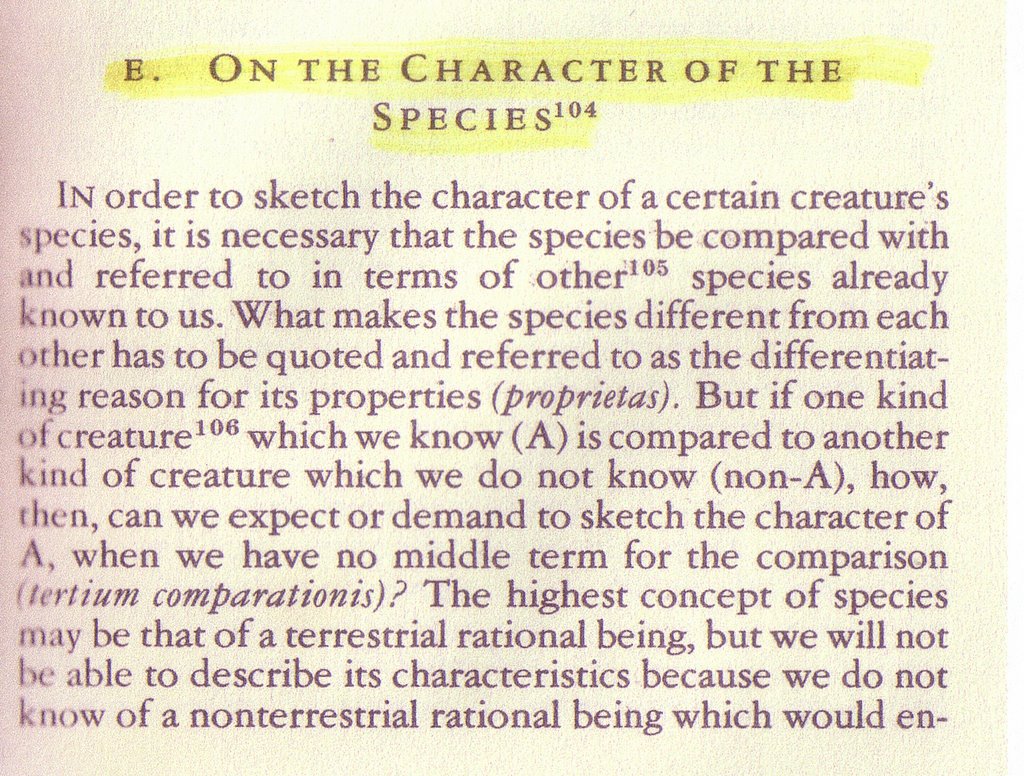
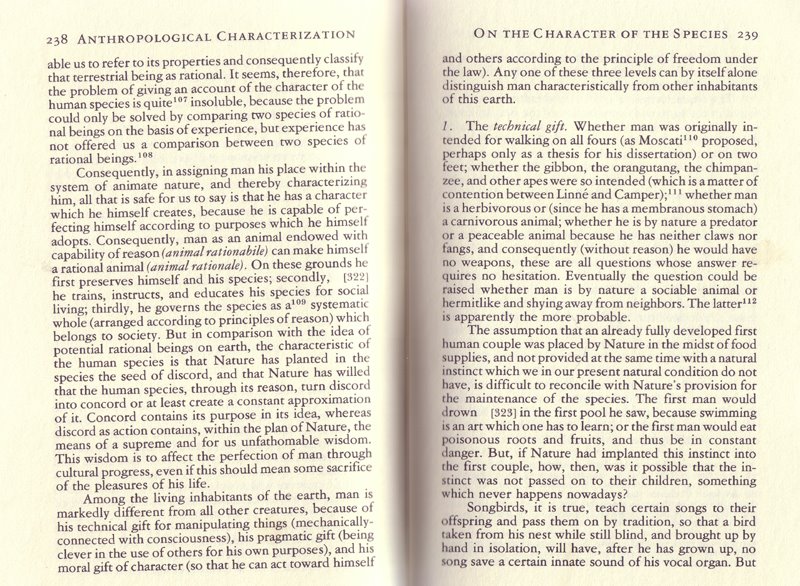
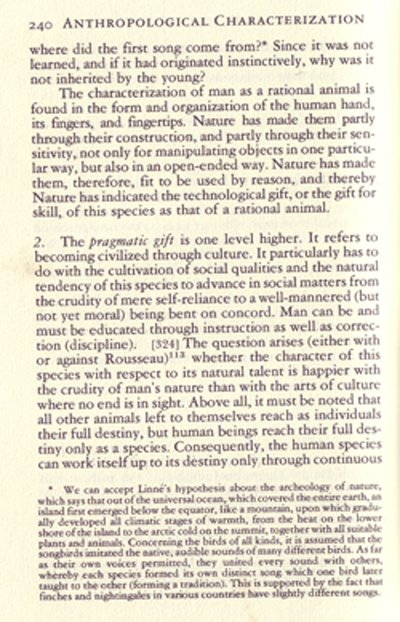
In Discussing Creationism Part XV, I gave this quote by Immanuel Kant, a German philosopher from the 1700's. He said that "[A]n orang-utan or a chimpanzee may develop the organs which serve for walking, grasping objects, and speaking – in short, that he may evolve the structure of man, with an organ for the use of reason . . . (Kant, 1798 in Anthropology). Some Evolutionists use this quote to support their argument. I wanted to find the context of this quote and found it in Kant's Anthropology from a Pragmatic Point of View from the Unversity library. It is in the section On the Character of the Species.

In this section, Kant asked what makes a species different from another. He stated that there has to be another species to compare the other with in order to define that species. Since there is not another animal that has the same ability to reason, it was impossible to characterize this ability. Reason must've come about due to man's own abilities. It is the absence of any other animal with the ability to logically reason that sets him apart from other living beings.

Kant differentiated man from other animals by their ability to manipulate (which he refers to technical gift), pragmatism and morality. Note that that the translation used in the following pages are different from the one originally used.

Kants stated that it doesn't matter if man walked on all fours because man's other attributes aren't the way they were originally either. His point here is not evolutionary but rather to show that man has the ability to manipulate matter as they have their hands free. "The characterization of man as a rational animal is found in the form and organization of the human hand, its fingers, and fingertips." This is a characteristic that is shared with monkeys and apes and this is why the comparison was given.

Kant does make reference to the Creationists' belief in Adam and Eve. Kant ponders why God would create a human couple without the ability to kill animals naturally for food or protection as humans have no claws or fangs. Man was also created without the ability to swim without instruction. Kant is not a Biblical thinker.

Man was created as a herbivore. See Genesis 1:29-30
"And God said, Behold, I have given you every herb bearing seed, which is upon the face of all the earth, and every tree, in the which is the fruit of a tree yielding seed; to you it shall be for meat.
And to every beast of the earth, and to every fowl of the air, and to everything that creepeth upon the earth, wherein there is life, I have given every green herb for meat: and it was so."

As for the inability to swim and the threat of drowning in their ignorance, Kant failed to recognize that Adam walked with God in the garden. God was man's teacher and He created man with the ability to learn and adapt oneself to different environments.


click on image to enlarge:


Discussing Creationism: The Initial Argument
Part II: Two Questions about the Ark
Part III:The Volume of the Ark
Part IV: The Weight and Sturdiness of the Ark
Part V:What is a Myth

Part VI: Gilgamesh
Part VII: The Biblical View of Noah
Part VIII: Gathering of the Animals
Part IX Evolution
Part X The First Evolutionist
Part XI The Notebook
Part XII Erasmus Darwin
Part XIII Aristotle
Part XIV Middle Ages
Part XV Kant's Quotation

Sunday, May 21, 2006

Discussing Creationism: Part XV

Immanuel Kant, 1724-1804, a German philosopher, reasoned that "[A]n orang-utan or a chimpanzee may develop the organs which serve for walking, grasping objects, and speaking – in short, that he may evolve the structure of man, with an organ for the use of reason . . . (Kant, 1798 in Anthropology)"
Evolutionary Psychology

Now, I would really like to find a copy of Anthropology so as to find the reasoning that led to this conclusion.

Discussing Creationism: The Initial Argument
Part II: Two Questions about the Ark
Part III:The Volume of the Ark
Part IV: The Weight and Sturdiness of the Ark
Part V:What is a Myth

Part VI: Gilgamesh
Part VII: The Biblical View of Noah
Part VIII: Gathering of the Animals
Part IX Evolution
Part X The First Evolutionist
Part XI The Notebook
Part XII Erasmus Darwin
Part XIII Aristotle
Part XIV Middle Ages

Sunday, May 14, 2006

Discussing Creationism Part XIV

*Revised May 15, 2006*

I am still curious about other pre-Darwinian evolutionary ideas.
I've already looked at:
Part XIII Aristotle
Part XII Erasmus Darwin

Using the web site,Pre-Darwinian Theories of Evolution as a time-line guide, I looked at the Middle or Medieval time period which is from the defeat of the Roman Empire to the Renaissance, approximately 500-1450 AD.

During the Middle Ages, the philosophy of Aristotle was rediscovered. Aristotle, a pupil of Plato, was a keen observationalist with a fondness for biology. He developed his own classification system, dividing the animals by the presence or abscence of blood. He believed that living matter had potential to grow into its perfect form.

There was discussion among scholars on how to reconcile the the Biblical account of creation with Aristotle's viewpoint. Debate and study into the matter was discouraged as disagreement with Church doctrine was punishable by death. However, Aristotle had considerable influence over the theologians of this time.

It is interesting that his thoughts should reappear.


Also in this series (Focus on Noah and the Flood):
Discussing Creationism: The Initial Argument
Part II: Two Questions about the Ark
Part III:The Volume of the Ark
Part IV: The Weight and Sturdiness of the Ark
Part V:What is a Myth

Part VI: Gilgamesh
Part VII: The Biblical View of Noah
Part VIII: Gathering of the Animals
Part IX Evolution
Part X The First Evolutionist
Part XI The Notebook

Sunday, May 07, 2006

Discussing Creationism Part XIII

After reading about Erasmus Darwin and his evolutionary speculations which preceded that of his grandson, Charles, I can see that pre-Darwinian evolutionary thoughts are important. They actually began with the Greek philosophers. There were many different ideas but the most popular are Plato and Aristotle. Both of these men wrote of an advancement towards the ideal, divine, unchangeable Form.


Aristotle's thoughts are the more evolutionary. He wrote that changes occurred from lifeless primeval matter to vegetation. Then, according to Aristotle, there was another transition from plants to animals. These transitions are a gradual progression from the lower forms to the highest which is man.

These ideas are captivating and interesting for sure, but are still speculative and unscientifically based.

Discussing Creationism: The Initial Argument
Part II: Two Questions about the Ark
Part III:The Volume of the Ark
Part IV: The Weight and Sturdiness of the Ark
Part V:What is a Myth

Part VI: Gilgamesh
Part VII: The Biblical View of Noah
Part VIII: Gathering of the Animals
Part IX Evolution
Part X The First Evolutionist
Part XI The Notebook
Part XII Erasmus Darwin

Sunday, April 30, 2006

Discussing Creationism Part XII

I am reading the book "The Theory of Evolution" by evolutionist, Cynthia L. Mills, in order to critically and analytically understand both evolution and creationism. This part of the discussion is a less formal, personal notebook of interesting information that I gather and jot down as well as my thoughts on the material. Feel free to offer your viewpoints, suggestions or other reading material recommendations.

Everyone is influenced by someone especially from their childhood. In the case of Charles Darwin, that person was his grandfather, Erasmus Darwin. Erasmus was a physician who liked to write poetry and prose and to speculate on scientific matters, especially the origins of life. He was a contemporary of Lamarck and came to similar conclusions, most notably that use or disuse of a part of the body could lead to changes in size or shape.
In Erasmus' popular book, Zoonomia or the Laws of Organic Life, he wrote his scientific views in a poetic manner.

"Nurs'd by warm sun-beams in primeval caves
Organic Life began beneath the waves...
Hence without parent by spontaneous birth
Rise the first specks of animated earth."


Erasmus' speculations were very similar to present day beliefs of the origin of life. Could it be that his thoughts influenced his grandson and others?

Erasmus is said not to have been an atheist but he did not accept the authority of the Bible or of the Christ.

In Discussing Creationism Part V, I wrote that "An important but often overlooked premise that is inherent in every man is their religious belief...The idea that scholarly men are impartial observers is often a fallacy. Christian beliefs also may lead to conclusions which are contrary to the non-religious man. These differences of premises can both lead to different interpretations of the facts."


Discussing Creationism: The Initial Argument
Part II: Two Questions about the Ark
Part III:The Volume of the Ark
Part IV: The Weight and Sturdiness of the Ark
Part V:What is a Myth

Part VI: Gilgamesh
Part VII: The Biblical View of Noah
Part VIII: Gathering of the Animals
Part IX Evolution
Part X The First Evolutionist
Part XI The Notebook

Sunday, April 23, 2006

Discussing Creationism Part XI


I am reading the book "The Theory of Evolution" by Cynthia L. Mills in order to understand critically
and analytically both evolution and creationism. This part of the discussion is more like a less formal, personal notebook of interesting information that I gather and jot down. Feel free to offer your viewpoints, suggestions or other reading material recommendations.

I found this statement of importance:
"Did new species come about suddenly or gradually? Darwin continued to be convinced evolution must be gradual, but never proved it to his or anyone's satisfaction. It has remained one of the central disagreements to this day."

I also found an interesting web page called "Darwinia and Evolution."

Here is a list from the above web page of what is necessary to understand the fossil record:
  • basic knowledge of geology and plate tectonics
  • radiometric dating (creationism does not agree with the dating methods that have been used. This is another discussion, of course. I just wanted to point this out.)
  • read a couple of books and journals on the subject
  • possibly take an introductory course in paleontology
  • keep up to date by subscribing to a paleontological news service

This seems to be an informative web page but it suggests an extensive study plan that could take 5 years. I will need to decide what to do. Meanhile I will continue on with this book on Evolution as it gives a good overview. There are also works that have been done by other creationists that I need to look at. I don't have to start from scratch.

Most importantly praying to the Creator for understanding and knowledge will help.

Discussing Creationism: The Initial Argument
Part II: Two Questions about the Ark
Part III:The Volume of the Ark
Part IV: The Weight and Sturdiness of the Ark
Part V:What is a Myth

Part VI: Gilgamesh
Part VII: The Biblical View of Noah
Part VIII: Gathering of the Animals
Part IX Evolution
Part X The First Evolutionist

Sunday, April 16, 2006

Discussing Creationism Part X


I have been reading "The Theory of Evolution" by Cynthia L. Mills. She is a scientific writer who has written articles for several magazines. In this book, she writes of the history of Evolution.

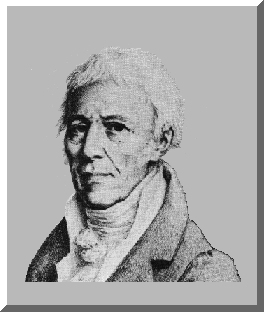
The first scientist to assert that one species changed to another species was not Darwin but Jean-Baptiste Lamarck. He was born in 1744. In 1793, he was assigned to the study of worms and insects at the Museum of Natural History in Paris. It was from this work that he formulated the idea of evolution.

In a lecture he gave in Paris in 1803, he stated "Do we not therefore perceive that by the action of the laws of organization . . . nature has in favorable times, places, and climates multiplied her first germs of animality... Then. . . aided by much time and by a slow but constant diversity of circumstances, she has gradually brought about in this respect the state of things which we now observe. How grand is this consideration, and especially how remote is it from all that is generally thought on this subject!"

Even earlier, in 1801, Lamarck had written "time and favorable conditions are the two principal means which nature has employed in giving existence to all her productions. We know that for her time has no limit, and that consequently she always has it at her disposal." The general scientific community did not listen and he died in poverty.

Early in his study of the invertebrates, he became convinced that organisms progressed from simple to complex forms. It wasn't until he inherited a fossil collection of mollusks and saw a chronological development within the collection that he began to believe that transmutation of species was possible.

Lamarck differed from Darwin:
  • in his belief in spontaneous generation which is the idea that life can occur spontaneously from non-living matter. He believed that it must have occurred throughout the course of history in order to explain the missing links between species in the fossil records.
  • in the theory of the "tendency to progression" (simple to complex) Darwin believed that life evolved as there was a need.
  • Lamark did not believe that extinction occurred. It only appeared that way because animals evolved into another form. Darwin believed that extinction occurred and natural selection, which states that adaptions occur if the environment demands it. Then those animals that are adapted the best will survive while those that are not will die out or become extinct.
Some points I wonder about as I read about Lamarck are:
  • Evolution is trying to understand nature and is itself evolving or changing in its ideas.
  • that animal life is similar. From the worms to man, there is a pattern to the life forms.
  • Science is both defined and limited by what man can deduce, think or imagine from the data.


Discussing Creationism: The Initial Argument
Part II: Two Questions about the Ark
Part III:The Volume of the Ark
Part IV: The Weight and Sturdiness of the Ark
Part V:What is a Myth

Part VI: Gilgamesh
Part VII: The Biblical View of Noah
Part VIII: Gathering of the Animals
Part IX Evolution

Sunday, April 09, 2006

Discussing Creationism Part IX


So now I approach the most crucial and difficult question regarding Noah and the flood. "Is it possible that the animals that exist today originated from the animals that were in the ark?" In Part III, I estimated that there were approximately 2500 different kinds of animals that could've fit in the ark. There are about 10 million species of animals and 9000 species of birds that exist today.

There was an uproar when Darwin published his theory of natural selection in "The Origin of Species" in 1859. The Biblical account of Creationism was the accepted viewpoint up to that time but Darwin and other scientists had begun to look at the evidence without this belief. Some religious people accepted the new ideas while others held to the Biblical beliefs of creationism and the history of the catastrophic flood.


The debate between the two sides has not ended and probably never will. I found this quote by Darwin that he wrote to Asa Gray, an American biologist, a suitable one for those that continue to study and debate the subject.
"My book has stirred up the mud with a vengeance; and it will be a blessing to me if all my friends do not get to hate me. But I look at it as certain, if I had not stirred up the mud some one else would very soon; so that the sooner the battle is fought the sooner it will be settled; not that the subject will be settled in our lives' time. It will be an immense gain, if the question becomes a fairly open one; so that each man may try his new facts on it pro and contra."

I want to examine these controversial and conflicting viewpoints closer. If you are interested, join me as I take closer looks at both Evolution and Creationism in order to try to answer the question asked above "Is it possible that the animals that exist today originated from the animals that were in the ark?"


Discussing Creationism: The Initial Argument
Part II: Two Questions about the Ark
Part III:The Volume of the Ark
Part IV: The Weight and Sturdiness of the Ark
Part V:What is a Myth

Part VI: Gilgamesh
Part VII: The Biblical View of Noah
Part VIII: Gathering of the Animals

Sunday, April 02, 2006

Discussing Creationism Part VIII

For the past 7 Sundays, I have been talking about the reality of Noah and the flood.

Discussing Creationism: The Initial Argument
Part II: Two Questions about the Ark
Part III:The Volume of the Ark
Part IV: The Weight and Sturdiness of the Ark
Part V:What is a Myth

Part VI: Gilgamesh
Part VII: The Biblical View of Noah

There was another question put forward and that is "How could Noah possibly have gathered all the animals from all over the world?"

Genesis 6:19-20 "And of every living thing of all flesh, two of every sort shalt thou bring into the ar, to keep them alive with thee; they shall be male and female. Of fowls after their kind, and of cattle after their kind, of every creeping thing of the earth after his kind, two of every sort shall come unto thee, to keep them alive."

What does this passage say?
That the animals came unto Noah.
This seems impossible to us today because we are not used to the different relationship that existed between man and animals then. Animals did not fear man. Read Gen 9:2-4, where the trusting relationship between man and animal turned to fear.
As well, we know that animals instinctively know what to do when disaster is looming.

Sunday, March 26, 2006

Discussing Creationism Part VII

Many people dismiss the Genesis account of the flood as being a myth, not to be taken literally. Many people even of religious persuasion have accepted the words of the the scientists and scholars, following along with the notion that the story is too fanciful to have really occurred.

What does the Bible have to say about the reality of Noah and the flood?

The book of Genesis is written as a historical account of the creation of the world and the patriarchs from these beginning days. Adam, Noah, Abraham, Isaac, Jacob and Joseph are all included in Genesis. In the 5th chapter of Genesis, a geneology is given from Adam to Noah. To the Jewish people, geneologies are very important. They would not have recorded the descendants of mythological characters. Genesis 10 gives the geneology of the sons of Noah. Chapter 11 focuses on the descendants of Shem, Noah's son, after the flood. From Shem's line, Abraham, the Jewish nation and eventually Jesus would arise. Both Noah and Adam are mentioned in the geneology of Jesus in Luke 3. Obviously, Noah was not mythological according to the Jewish records that were kept.

Noah is mentioned as a man of great faith in Hebrews 11:7. "By faith Noah, being warned by God about things not yet seen, in reverence prepared an ark for the salvation of his household, by which he condemned the world, and became an heir of the righteousness which is according to faith."

Again, Noah is mentioned by the apostle, Peter, talking about God not sparing the ancient world, "but preserved Noah, a preacher of righteousness, with seven others, when He brought a flood upon the world of the ungodly." 2Peter 2:4-5

Both of the above passages clearly state that Noah existed and that the flood occurred. According to the Bible, Noah, the ark and the flood were not a myth.


Discussing Creationism Part I
Part II
Part III
Part IV
Part V

Part VI

Sunday, March 19, 2006

Discussing Creationism Part VI

There have been many accounts written about a devastating flood from ancient cultures. These vary in their details. To simplify this discussion however, I will refer to only one which was put forward several times in the past Sunday posts, the flood in the book of Gilgamesh.

Gilgamesh was a Mesopotamian king around 2800-2500 BC. In this collection of
stories, written around 2150 BC , Gilgamesh is a hero that searches for fame and immortality. In one of the quests in the book, he comes upon Ut-napishtim who was a wise man building a boat to "save the seed of all living things." Gilgamesh stayed on the boat with Ut-napishtim and his wife. Later, Gilgamesh is offered a chance by Ut-napishtim to have eternal life but because of his human weakness, he loses his opportunity. (The fact that Gilgamesh was included in the infamous flood story is a witness to his popularity, similar to Ovid including Roman emperors in Metamorphosis. )

Unlike the Genesis account of the flood which is written in a matter of fact style, Gilgamesh is written poetically probably for entertainment purposes. "The specific purpose for which (Gilgamesh) was composed is a difficult question, but the general purpose for which the epic and its constituent stories existed in oral form is very probably entertainment." Myths from Mesopotamia: Creation, The Flood, Gilgamesh and Others-Stephanie Dalley

One of the questions brought up in this discussion was which account came first, the Biblical or Mesopotamian. Gilgamesh was written down around 2150 BC while the Biblical version was written around 1500 BC. Some might conclude that because the Mesopotamian version was written first means that it is the original version.

It is evident from the many similarities in these accounts that there was a common source. The fact that many early cultures have a flood story shows that there must've been an actual flood of devastating proportions. The common source would be the flood itself.

In the Biblical account, Noah has three sons, Shem, Ham and Japheth. From these three sons arose three distinct cultures from which further cultures arose. After the Tower of Babel, the people of the earth were separated because of their different languages. (another discussion, please) Memories of the flood would've been passed down from generation to another in these different separated cultures. Different versions would naturally arise as not all people believed in God but had various beliefs.
This explains the different versions of the same story. The Hebrew race were descended from Shem from which the Biblical version of the flood would have been passed down from.

Discussing Creationism Part I
Part II
Part III
Part IV
Part V

Sunday, March 12, 2006

Discussing Creationism Part V

In this series about Creationism in which we are currently examining Noah and the flood, the issue of mythology needs to be addressed:

What is a myth?

Answers.Com defines a myth as:

1. A traditional, typically ancient story dealing with supernatural beings, ancestors, or heroes that serves as a fundamental type in the worldview of a people, as by explaining aspects of the natural world or delineating the psychology, customs, or ideals of society: the myth of Eros and Psyche; a creation myth.
2. Such stories considered as a group: the realm of myth.
2. A popular belief or story that has become associated with a person, institution, or occurrence, especially one considered to illustrate a cultural ideal: a star whose fame turned her into a myth; the pioneer myth of suburbia.
3. A fiction or half-truth, especially one that forms part of an ideology.
4. A fictitious story, person, or thing: “German artillery superiority on the Western Front was a myth ” (Leon Wolff).


Myths are fictitious stories which arise from the oral traditions of ancient, primitive people. It is possible that oral traditions which weren't immediately written down and superstitious beliefs can distort facts but this does not mean that all ancient accounts are false and are to be classified as myth. Some stories, such as the Greek and Roman myths, were written as allegories by intelligent men with great understanding of human nature but they helped add to the belief that all accounts from antiquity are allegorical and not be taken as truth.

The following is a list of what makes a myth, from About Com:

A myth is a story containing within and having about it certain identifiable characteristics. These are, specifically, that:

* It is a religious story, no matter from which culture and will therefore involve the existence and activities of a supernatural being, such as a god, a demigod, a goddess, or several such entities;
* It will seek to explain at least some aspect of the origin or manner of things (where people came from, how rainbows first came to be, why whales have blow spouts, why people and animals feel hunger) if not of the very universe itself;
* It is not an isolated tale but connects up in some significant way with other similar stories within a culture, involving other deities who collectively form a pantheon;
* Its authorship is communally shared, that is, attributable to no single person, and it came into existence through oral tradition, and therefore usually has more than one version;
* It is believed to be essentially true by those in the society for whom it is one part of a cultural mythology.

The Biblical accounts of Creationism and Noah certainly meet all these criteria but remember, this classification system is devised by man. This list presumes that all early accounts are false and that it is only that society from whom it originates that considers it true.

In mathematics, it is easy to check the computations for mistakes, but to examine an argument, one has to look at the premises, one at a time, to check for truth or error.

An important but often overlooked premise that is inherent in every man is their religious belief. A well meaning and intelligent man,Joseph Campbell, is a world renown scholar on mythology. He teaches that the Bible is a "tribally circumscribed mythology." He is also an atheist. His beliefs cause him to interpret the Bible in a certain way. The idea that scholarly men are impartial observers is often a fallacy.
Christian beliefs also may lead to conclusions which are contrary to the non-religious man. These differences of premises can both lead to different interpretations of the facts.

So when looking at these arguments, on what is a myth or what does this ancient document really mean, it is necessary to keep these differences in premises in mind.

Do you have any ideas to add regarding the definition of mythology?

Discussing Creationism Part I
Part II
Part III
Part IV